Showing posts with label USA Facts. Show all posts

Wednesday, June 10, 2026

USAFacts: "How are Americans doing financially?"

"Last week, we talked about how people felt about the economy. Now let’s zoom in: How do people feel about their personal finances? The Federal Reserve tracks Americans' sentiment about their financial situations, including their main financial challenges, and it turns out people are feeling the pinch of higher prices.
USAFacts: "How are Americans doing financially?"
https://usafacts.org/articles/how-are-americans-doing-financially/
  • In 2025, 28% of US adults reported being worse off financially than the previous year. This is similar to 2024, when 29% of adults reported being worse off, but down from 35% in 2022. 

  • The share of Americans who say they are doing okay or better financially has remained near 73% since 2022, down from a recent high of 78% in 2021.

  • Price increases were the top financial challenge among adults last year, with 91% reporting them as a concern. Saving for retirement was the second most common challenge: 72% of Americans reported it as a concern.

  • Eighty-six percent of people with at least a bachelor’s degree reported doing at least okay, compared to 64% of people with high school diplomas or GEDs and 41% of people who didn’t finish high school.

  • Over the 13 years of available data, Asian adults consistently reported the highest rate of financial security, followed by white adults. Black and Hispanic adults reported the lowest rates."


Sunday, May 17, 2026

Steve Ballmer explains the Federal Reserve (video)


Just the Facts on the Fed
 
The newly confirmed Fed Chair Kevin Warsh is beginning his tenure as head of the Federal Reserve. The Fed is the nation's central bank, but you can’t walk into a branch to open a checking account. Instead, the Fed's decisions can make your car payments cheaper or a job harder to find.
 
So how does the Fed work? Glad you asked! USAFacts Founder Steve Ballmer just dropped this new video on the Fed and we couldn’t wait to share it with you. 
Join Steve as he breaks down the Federal Reserve's complex role in the American economy. He'll break down complicated concepts, provide visuals to shed light on the institution, and even make a few costume changes. 
 
This is the first Spotlight edition of the USAFacts newsletter, which we’ll send when we have a cool new way to explore data with you. You can expect to get them about once a month. 
 
Here's a preview of what you'll find in the video, plus data to understand the Fed's role in your economic well-being:  
The Federal Reserve is the most important bank you’ll never use.
  • It’s a bank for banks. It holds cash reserves, moves money between banks, and can lend to them whenever needed.

  • The Fed has five responsibilities. The one that affects you most directly is its mandate to conduct monetary policy to keep inflation in check and employment high. Through it, the Fed can influence interest rates across the entire economy. (Here are the other four.)  
Speaking of inflation
  • When the Fed lowers interest rates, it can lead to the running economy “hot.” It can make it cheaper for you to buy a house, get a car loan, or borrow money to open a business. But if money’s easier to borrow, it can fuel inflation.

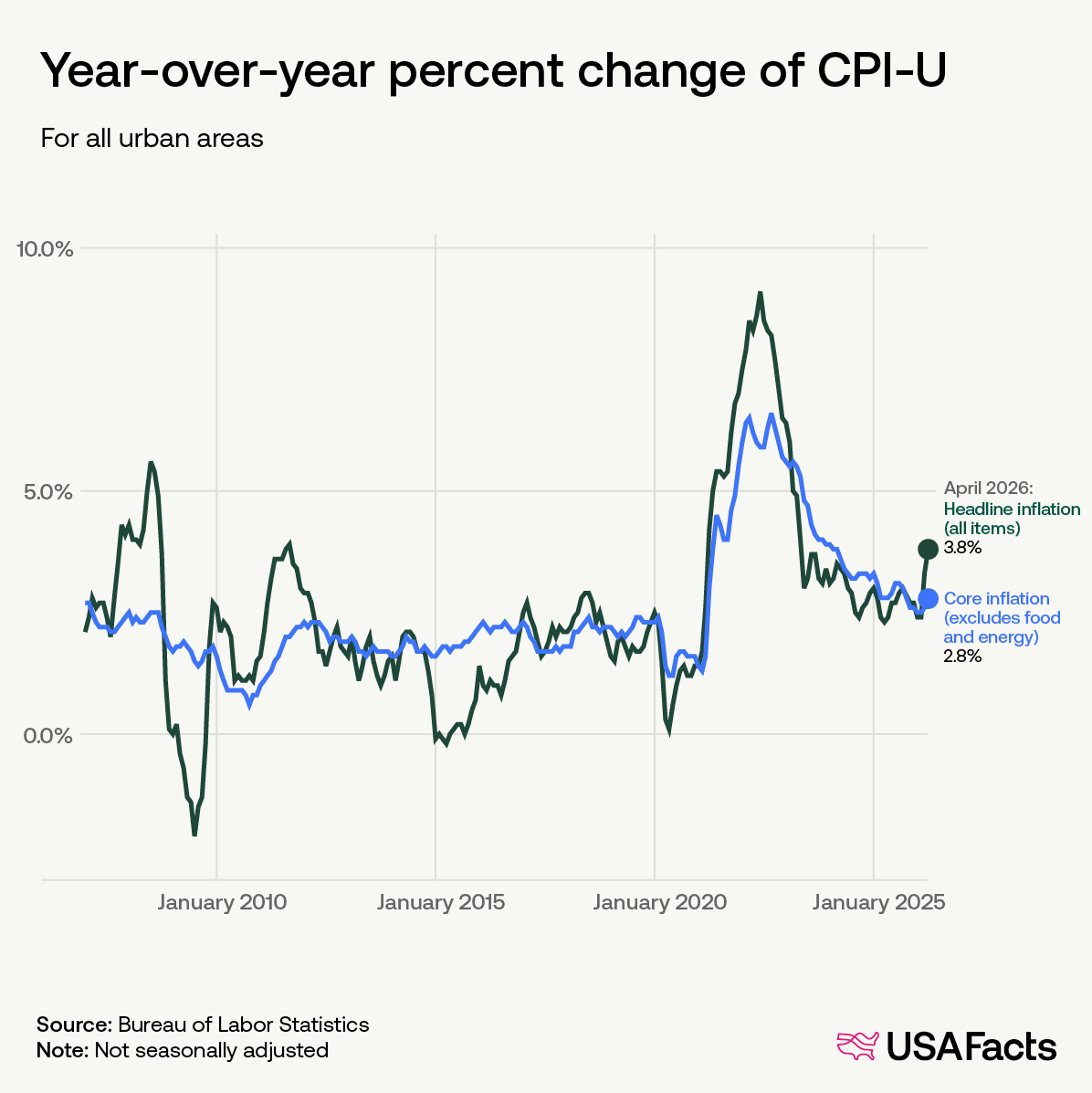
  • Last month’s inflation rate was 3.8%. The Bureau of Labor Statistics measures inflation through changes in the Consumer Price Index (CPI), a metric designed to track the price of a “basket of goods and services.” 
  • Think a dollar doesn't go as far as it used to? You're right. Track how the dollar’s value has changed with our inflation calculator! Explore the value from 1913 to now, or at any point in between.

  • Workers’ wages aren’t keeping up with inflation. Nominal wages rose 3.6% from April 2025 to April 2026, while prices grew 3.8%.

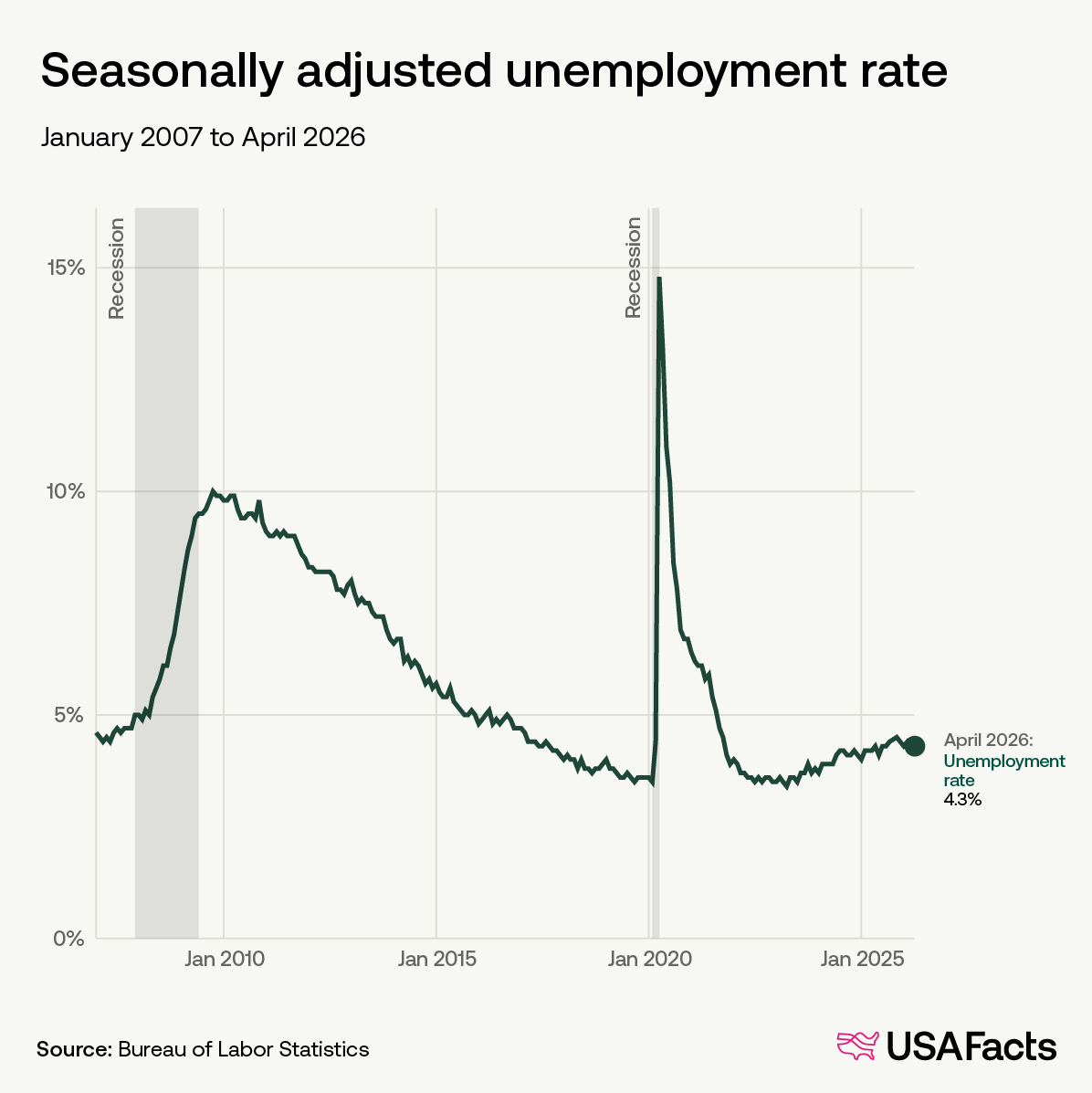
  • When the Fed raises interest rates, it can lead to the economy running “cold,” making things more expensive and slowing inflation. When borrowing is hard, it can slow the economy and drive up unemployment.  
How the Fed influences interest rates
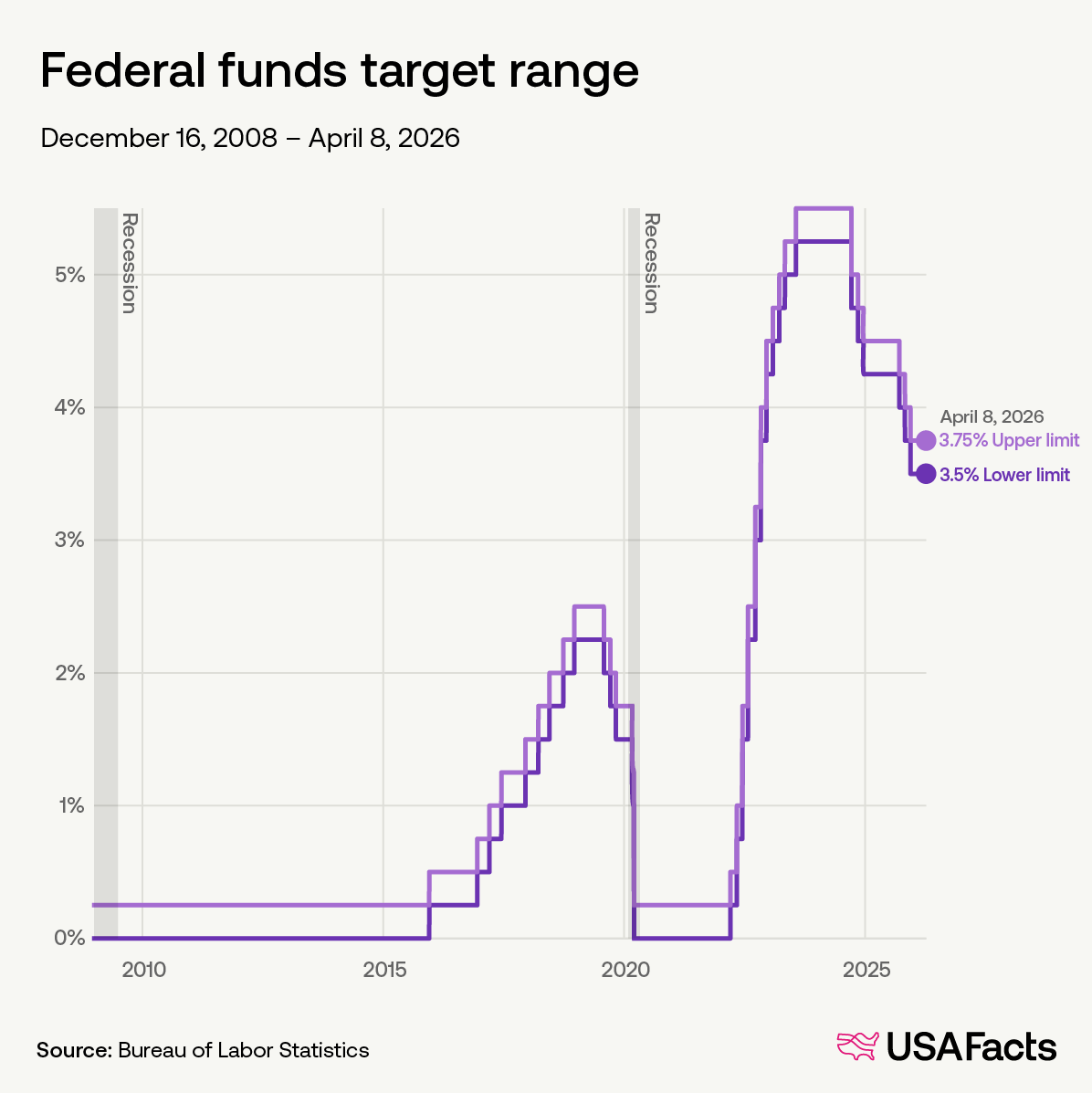
  • The Fed changes the interest it charges on loans it gives and pays on other banks' cash reserves it holds, effectively setting the limits at which other banks can charge interest. The average overnight rate at which banks transact is called the federal funds rate. Get a jargon-free explanation of the federal funds rate from Steve himself.
  • If the Fed raises the federal funds range, your bank’s costs go up. Your bank might raise interest rates on new loans. Mortgages, car loans, credit cards, and short-term business loans all get more expensive. That can ripple across the economy: people buy less, inflation can decrease as demand falls, less demand means companies may need fewer workers — causing unemployment to rise.

  • The federal funds rate target range has changed about 30 times in the last 10 years. In 2022, inflation climbed well above the Fed’s 2% goal. In response, the Fed raised the federal funds target range seven times in a single year. 
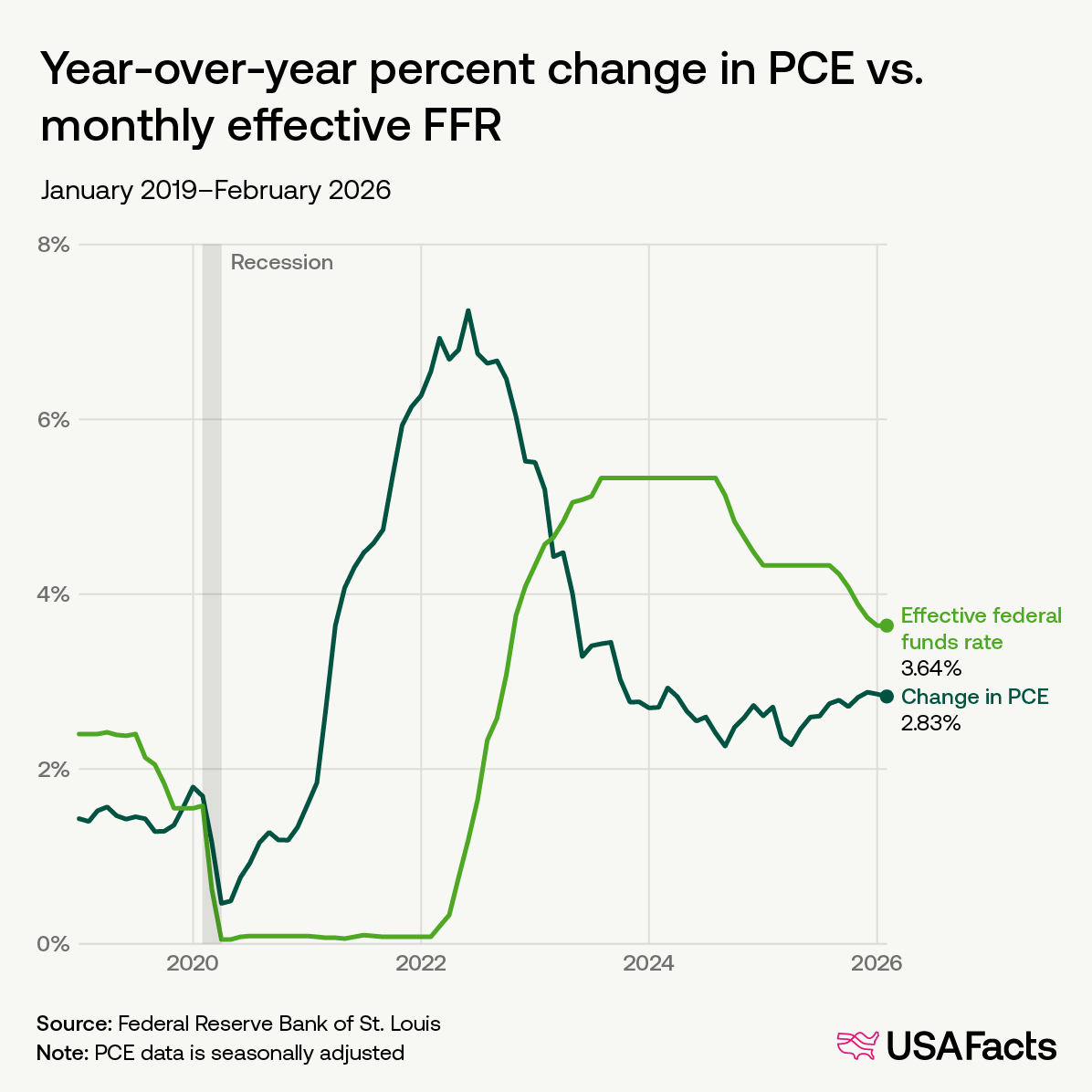
  • The Fed uses the Personal Consumption Expenditures Price Index (PCE) to measure inflation. The PCE tracks changes in the prices consumers pay across the economy. This differs somewhat from the CPI (the inflation measure most Americans are familiar with) because the two indexes use different methods and baskets of goods and services to calculate price changes.

  • Sometimes interest rate changes aren't enough, so the Fed uses other tools. One of them is to create money. (Sounds nice, right?) Here’s how
 
Thank you for joining us for this first Spotlight email! Watch the video now, then learn more about the Federal Reserve


Was this email forwarded to you? Sign up here for your own weekly issue of the USAFacts newsletter.

Copyright© 2026 USAFacts All Rights Reserved. PO Box 1558 Bellevue, WA 98009-1558

Wednesday, March 11, 2026

Vacancy rates by state across the US In 2024

Vacancy rates by state across the US In 2024
*Checks Zillow*

In 2024, Maine, Vermont, and Alaska had the highest gross vacancy rates — 1 in 5 homes was vacant in Maine. The national rate dropped to 10.3% that same year (a 25-year low).

Since 2009 (post ‘08 housing crisis), gross vacancy rates were lower in every state in 2024. Where it dropped most:
Florida: -8.8 net change
Arizona: -7.8
Alaska: -7.4


More from USA Facts - https://www.instagram.com/usafacts


Friday, January 30, 2026

USA Facts: Which states contribute more than they receive?

USA Facts: Which states contribute more than they receive?
"In FY 2024, the federal government collected around $5.07 trillion from states and their residents. With 38% coming from the nation’s 4 most populous states: California (15.9%), Texas (8.2%), New York (7.6%), and Florida (6.4%).

19 states sent more money than they received — California has the largest difference of $276B between what they sent and what they got back.

About $4.87 trillion was redistributed back to states and residents through programs like Social Security, Medicaid, Medicare, food stamps, and education grants.

The states that received the most funds compared to what they paid were:

📍 Virginia (+$89B)
📍 Alabama (+$45B)
📍 South Carolina (+$39B)

Where does your state fall?"

* Mass is in the Top 19 in sending more than receiving back


See more at USA Facts -> https://usafacts.org/

Monday, December 29, 2025

USA Facts on core inflation

Via USA Facts:

"Core inflation (excluding food and energy) dropped to 2.6%, the lowest since early 2021. Headline inflation fell to 2.7%.

The government shutdown disrupted data collection, so figures blend September and November with carried-forward October estimates."


Monday, December 8, 2025

USA Facts video series - well worth binging !! (video)

The 6 part series by Steve Ballmer and USAFacts is worth binging. Each episode is between 6 and 10 minutes.

USA Facts video series - well worth binging !!


It is recommended to start with episode 1

You can also go directly to the USAFacts page and try their interactive version which is still in beta test.  https://usafacts.org/just-the-facts/

Why share these? The terminology and principles also apply here in Franklin.

Affordable being a key term. In the discussions I have at the Senior Center (and elsewhere), I always qualify "affordable" as Capital A - that defined by the Federal and State process, or little "a" - the affordable that can be covered by what is in our wallet or income reach.

Tuesday, October 7, 2025

Early voting is increasing per USA Facts

Per email from Franklin's Town Clerk Nancy Danello, the ballots for the Nov 4 biennial election were received on Monday, Oct 6 and turned around to be mailed to the 400+ voters who requested mail ballots.  Early voting begins in the Town Clerk's office on Friday, October 17.

To see this come across the news feed was timely and share worthy.


Early voting is increasing per USA Facts
Do early and mail-in ballots really make a difference? 
Well, in 2024, early and mail-in ballots accounted for nearly 60% of all votes — that’s up from about 50% in 2022. 
  • 29% voted by mail 
  • 30.7% voted early in person 
  • Only 39.6% voted at the polls on Election Day 
Let’s dig deeper:️ 
  • Mail-in voting is most popular in the West 
  • Early in-person voting dominates in the South 
And who’s most likely to vote early or by mail? 
  • Voters 65+: 36.8% voted by mail 
  • Asian voters had the highest mail-in rate 
  • Black voters led in early in-person turnout 
  • Naturalized citizens were nearly 8 points more likely to vote by mail than native-born citizens


Monday, September 1, 2025

USA Facts lays out what programs immigrants are eligible for (chart)

Are immigrants eligible for government assistance? It depends on their immigration status.

Recent laws (including the One Big Beautiful Bill) have limited some immigrants’ access to government programs — but which ones, and for whom?

We broke it down in a new table to help make sense of this complicated system.

USA Facts lays out what programs immigrants are eligible for (chart)

The USA Facts page has an interactive chart, scroll over it to get additional info ->

Tuesday, July 8, 2025

Just the Facts About US Trade & Tariffs (video)

Steve Ballmer talks through US trading partners, imports & exports and how tariffs factor in In 2024, the US imported $4.1 trillion and exported $3.2 trillion in goods and services. Higher tariffs can raise prices and the US jobs impact is complex (lower tariffs can cause job losses in some sections and job gains in others).


Wednesday, June 11, 2025

USAFacts: How many people seek asylum in the US?

Asylum is a form of protection for people fleeing persecution in their home countries. Some request it after arriving in the US (affirmative asylum); others apply while facing deportation from the US (defensive asylum). How many people seek asylum here, and where do they come from? Here's the latest data from the Department of Homeland Security. 
  • USAFacts: How many people seek asylum in the US?
    USAFacts: How many people seek asylum in the US?
    Between 1990 and 2021, the US admitted 767,950 asylum seekers. In 2021, asylee admissions dropped to 17,692, the fewest since 1994. 
  • Chinese nationals were the largest group of asylum seekers from 2012 to 2021, comprising approximately 63,000 people. That was more than one-fifth of the asylees entering the US. 
  • Between 2013 and 2022, the government granted 27,868 Chinese nationals with affirmative asylum. Venezuelans (20,688), were the second-largest group of affirmative asylees, followed by Egyptians (14,909).  


Wednesday, June 4, 2025

Watch "US Federal Income Taxes: How the US Federal Government is Funded & How Your Share is Calculated" on YouTube

Via USA Facts: 

"The US federal government collected $4.9 trillion in revenue in 2024 -- 99% of it from taxes. 49% came from federal income tax and 35% came from payroll taxes (for social security and medicare). The US has a progressive tax system, which means that you pay more taxes on each income tier (in 2024 for single filers, 10% on your first $11,600, 12% on $11,604 to $47,150 and so on). And you can deduct some expenses (like mortgage interest) from your taxable income amount. More Americans are in the 12% tax bracket than any other. Learn more about how personal federal income taxes work, as well as corporate taxes, state and local taxes, and tax changes over time. "

For more info:


Wednesday, February 26, 2025

Fderal Government spending in one handy chart via USA Facts

At USAFacts, we believe that American taxpayers — the shareholders responsible for providing most government funding — are entitled to information on how the federal government and its budget operate. Every year, the federal government brings in and spends trillions of dollars.  
 
We've spent weeks combing through spreadsheets to help you track where that money goes. 

This new, searchable visualization displays government revenue from taxes and other sources, totaling $4.9 trillion for fiscal year 2024 and the $6.8 trillion the government spent.  
 
This chart even allows you to see spending data on specific federal agencies and programs. For example, type "Department of Labor" into the search bar at the top right of the visualization, and you'll see the department spent $66.2 billion in FY 2024. 

This new, searchable visualization displays government revenue from taxes and other sources
This new, searchable visualization displays government revenue from taxes and other sources