Providing accurate and timely information about what matters in Franklin, MA since 2007. * Working in collaboration with Franklin TV and Radio (wfpr.fm) since October 2019 *
"How did the first Secretary of Education convince the public to invest their tax dollars into schools?
He did his homework. Horace Mann rode horseback across Massachusetts, physically inspecting school buildings and gathering hard data on their crumbling conditions. He published his findings in 12 famous Annual Reports that served as a roadmap for modernizing curriculum, improving physical classrooms, and securing permanent state funding. He proved that public schools were the ultimate investment in society's future.
Check out tthe link below to listen to his annual reports:
From the biograpies that I have read about Horace, it was his wife Mary who provided the secretarial services putting together the reports from notes and drafts Horace created.
"Before becoming known as the "Father of American Education," Horace Mann’s vision was shaped directly by his own early schooling in Franklin, Massachusetts.
Looking back at early 19th-century education shows just how transformative his Common School movement truly was:
From Fragile Classrooms to Modern Learning Spaces: Early district schooling often meant crowded, unheated, one-room schoolhouses with minimal supplies. Mann led the push for dedicated, well-equipped facilities designed specifically for student health, comfort, and engagement.
From Seasonal Attendance to Consistent School Years: Tied to the agricultural calendar, Mann received only 8 to 10 weeks of formal schooling per year. His reforms established standardized, full-length school years so every student could build continuous foundational knowledge.
From Rote Drill to Professional Educators: Teaching was once a transient, largely untrained role reliant on rote memorization. Mann pioneered the creation of "Normal Schools"—the nation's first teacher-training colleges—elevating teaching into a respected, skilled profession centered on curiosity and critical thinking.
Mann’s childhood inspired a principle that continues to guide our schools today: every child, regardless of background or circumstance, deserves access to a free, high-quality, and well-supported public education."
"Netflix cofounder and Anthropic board member Reed Hastings joins TED's Sal Khan to give a look inside the race to build AI.
Hear his take on how the technology could accelerate education — including the possibility of an AI tutor for every student — and reshape the economy faster than anyone expects.
"I am thrilled to share that @jared.cooney.horvath renowned neuroscientist and author of “The Digital Delusion” will be joining me @aimeebergergirvaloctand @senatorjamesmaroney for a conversation on the impact of classroom technology on our kids’ learning.
Jared is to ed tech what @jonathanhaidt is to cellphones.
The Franklin Fire Department is pleased to announce it has been awarded $13,117 in state fire safety grant funding from the Massachusetts Department of Fire Services.
The department received $9,367 for the Student Awareness of Fire Education (SAFE) Program and $3,750 for the Senior SAFE Program for 2026.
These grants are part of a broader initiative by the Healey-Driscoll Administration, which awarded nearly $2 million statewide to support fire safety education for children and older adults. The SAFE programs provide critical resources to local fire departments to deliver life-saving education and prevention initiatives in their communities.
The SAFE Program focuses on teaching school-aged children how to recognize fire risks and respond safely in emergency situations. The Senior SAFE Program addresses fire risks among older adults through education, home safety improvements and partnerships with local service organizations.
“These grant funds allow our Fire Department to continue providing essential fire safety education to some of our most vulnerable populations,” said Fire Chief Chuck Allen. “By reaching both students and seniors, we are helping to prevent emergencies before they happen and ensuring residents are better prepared to stay safe.”
The Association of Independent Colleges & Universities in Massachusetts (AICUM) has named State Representative Jeffrey N. Roy (D-Franklin) a Legislator of the Year, honoring his sustained leadership and advocacy for higher education. The award was presented at AICUM’s annual meeting at Bentley University and the award portion can be viewed at https://tinyurl.com/5ea3wwfu
Representative Roy was recognized alongside Senator Barry Finegold (D-Andover) for his strong support of Massachusetts’ private, nonprofit colleges and universities—an essential sector represented by AICUM’s 58 member institutions.
(L-R) Rob McCarron, State Rep Jeff Roy
“Chair Roy has consistently demonstrated a deep understanding of the critical role private colleges and universities play in driving the Commonwealth’s economic vitality,” said AICUM President and CEO Rob McCarron. “From the local impact of Dean College in Franklin to the world-class research that fuels Massachusetts’ competitive edge, he has been a steadfast champion for higher education.”
McCarron emphasized the importance of leaders who recognize the far-reaching influence of higher education—not only on campus communities, but on regional economies, workforce development, and the success of students and families across the state.
Over his 14 years in the Legislature, Representative Roy has been a leading voice on education policy, including serving as Chair of the Joint Committee on Higher Education from 2019-2021. His commitment is rooted in personal experience: as a first-generation college graduate and former member of the Franklin School Committee. He understands firsthand the transformative power of education. In Massachusetts, where more than 70% of jobs require education beyond a high school diploma, that perspective has shaped his work to expand access and opportunity.
“My higher education journey changed the trajectory of my life,” said Representative Roy. “I’ve made it my mission to ensure every student has access to that same life-changing opportunity. This recognition reflects our shared commitment to expanding access, affordability, and opportunity across the Commonwealth. I’m grateful to AICUM for this honor and for their continued work on behalf of students.”
We have the opportunity to protect the next generation’s ability to think, question, and become fully themselves. Our values as a Commonwealth demand we take it.
We have the opportunity to protect the next generation’s ability to think, question, and become fully themselves. Our values as a Commonwealth demand we take it.
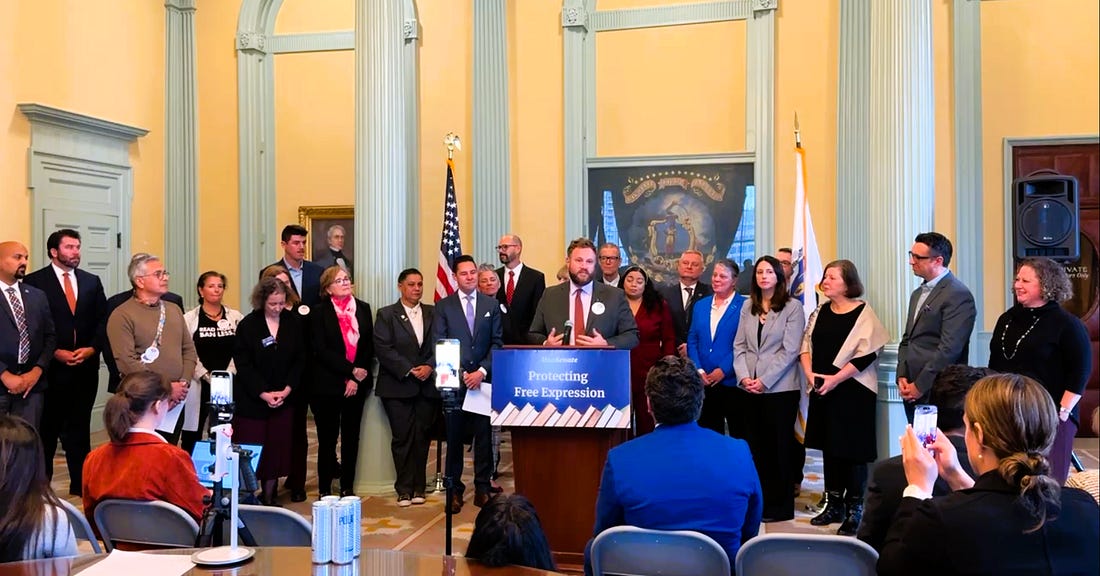
State Senator Julian Cyr speaks at a press conference featuring lawmakers, advocates, writers and librarians in support of his Protect Free Expression bill.
Before I ever held elected office—before I understood the mechanics of government or the levers of policy—I was a high school student on Cape Cod trying to make sense of the world around me.
At Nauset Regional High School in Eastham, I first got involved in organizing by speaking up with my classmates to protect the arts programs and teachers who helped shape who we were and who we’d become.
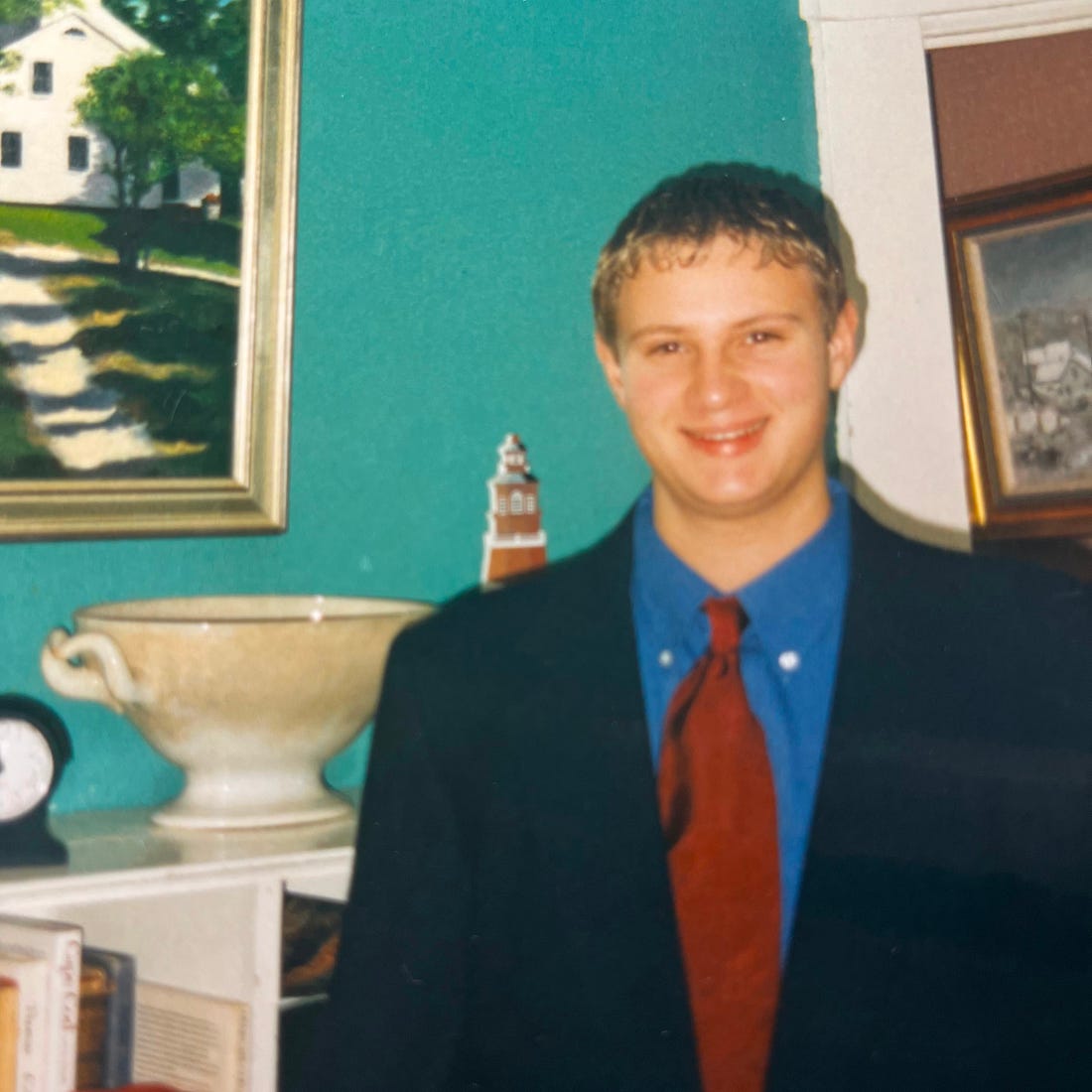
Senator Julian Cyr as a teen.
That experience taught me something I’ve carried ever since: young people deserve to be trusted with complexity, not shielded from it. Books are a fundamental part of that.
The books I read in my teens gave me language for things I didn’t yet fully understand, and perspective on lives that looked different from my own. Books helped me ask questions, challenge assumptions, and, over time, better understand myself.
That’s why I find the current wave of book ban efforts so troubling and so fundamentally at odds with what education—and our democracy—is supposed to be.
Thanks for reading The Gavel Drop! This post is public so feel free to share it.
If passed by the House, any differences between the House and Senate versions will need to be reconciled—most likely in a conference committee—before the bill heads to Governor Healey’s desk for her review and signature.
For Your Consideration
If preventing politically-motivated book bans is important to you, please:
FM #1726 = This is the Franklin Matters radio show, number 1726 in the series.
This session of the radio show shares the Finance Committee Budget Hearing on Education, the 2nd of 4 sessions to go over the FY 2027 budget. The meeting was held in Council Chambers with 8 of 9 members present.
Quick Recap:
Time spent at the opening to answer questions carried over from the Facilities discussion on Monday
Technology, Tim Raposa presents and answers questions
Next up, Schools - Supt Giguere, Business Manager Jana Melotti, Paul Griffith (SchCmte Chair)
Discussion among the committee on how to proceed, ultimately will use the Thursday session to consolidate their approaches in a discussion to lead to a recommendation vote.
Note - meeting location likely to change from Chambers to 3rd Floor Trng Room (Conservation Commission would come down to Chambers).
If you have questions or comments you can reach me directly at shersteve @ gmail dot com
The music for the intro and exit was provided by Michael Clark and the group "East of Shirley". The piece is titled "Ernesto, manana" c. Michael Clark & Tintype Tunes, 2008 and used with their permission.
I hope you enjoy!
------------------
You can also subscribe and listen to Franklin Matters audio on iTunes or your favorite podcast app; search in "podcasts" for "Franklin Matters"